
Palm Vein Recognition
Palm vein recognition (also called palm vein authentication or vascular biometrics) is a contactless biometric method that identifies a person from the unique pattern of veins beneath the skin of their palm, captured using near-infrared light and fused with a visible-light scan of the palm’s surface.
Because the vein pattern sits under the skin, it can’t be photographed, lifted or copied the way a fingerprint or face can — making it one of the most secure biometric modalities available today.
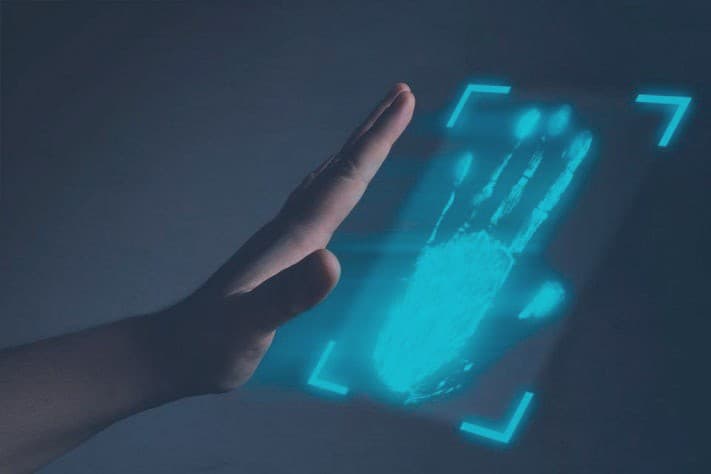
From hovering hand to verified identity in under a second.
Why near-infrared light?
Deoxygenated haemoglobin in the blood absorbs near-infrared (NIR) light. When a sensor shines NIR light through the palm, veins appear as dark lines against the surrounding tissue — a high-contrast pattern that’s completely invisible to the naked eye and to a standard camera.
Gekonova’s proprietary algorithms extract that vein structure and convert it into a digital biometric template, which is secured with AES-256 encryption before it’s ever compared or stored. We do not capture or retain raw palm images.
Why veins beneath the skin?
Vein patterns are formed in the womb and stay structurally stable for life — they don’t wear down, scar over, or change with a haircut or a sunburn the way surface features can. Even identical twins have different vein patterns.
Because the signal is internal and requires live blood flow to appear at all, there’s no external material — no photo, mould or print — that can reproduce it convincingly. That is what makes palm vein naturally resistant to spoofing.
Two palm vein scanner architectures, matched to the deployment.
Every Gekonova palm vein reader is built around one of two sensor designs, chosen for the environment it needs to work in.
Near-Infrared (NIR) Sensors
The foundation of palm vein biometrics. A controlled beam of NIR light penetrates the skin and is absorbed by the veins; the reflected light is captured to form a detailed image of the subcutaneous vein structure.
Contactless by nature, NIR sensors suit hygiene-critical settings — healthcare, laboratories, public-access terminals — where nothing should ever need to touch a shared surface.
Hybrid NIR–Camera Sensors
Adds a high-resolution camera to the NIR sensor, capturing surface characteristics — palm shape, print texture — alongside the vein pattern for dual-modality (RGB + IR) matching.
This fusion improves adaptability across skin types and environments, and is the architecture behind Gekonova’s higher-security terminals for banking, government and national infrastructure.
What actually gets stored isn’t a photo of your hand.
What’s stored is a mathematical representation — a feature template — derived from the vein and surface pattern. It cannot be reverse-engineered back into a viewable image, and it’s meaningless outside Gekonova’s matching engine.
- AES-256 encryption for data at rest, TLS/SSL in transit
- Liveness detection — presentation attack detection (PAD) — defeats photographs, prints, moulds and video replay
- 1:1 identity verification or 1:N identity search, both sub-second
- Data can live entirely on infrastructure you own and control
- Records can be deleted on request, with an auditable deletion history
Accurate enough for financial-grade decisions.
Small-model default threshold performance
Under the default matching threshold, each modality is independently tuned to a false-accept rate (FAR) of one in a million:
| Modality | Metric | Result |
|---|---|---|
| RGB Palmprint | FRR @ FAR | 1.002% @ 1e-6 |
| NIR Palm Vein | FRR @ FAR | 1.52% @ 1e-6 |
Both modalities reach a FAR level of one in a million on their own. Because a false accept requires the RGB palmprint and NIR palm vein modalities to fail at the same time, the combined false-accept risk falls to roughly one in hundreds of billions — the dual-modality figure quoted above.
Large-scale model — for higher-assurance deployments. The figures above reflect Gekonova’s default, small-model matching threshold. For banking-grade, national ID, and other high-stakes deployments, Gekonova also offers a large-scale matching model: trained and tuned for larger enrolled populations, it pushes both the false-reject rate and the false-accept rate below the small-model defaults, at the cost of additional compute per match. We size the right model tier during scoping, based on your enrolled population and required assurance level.
Figures reflect independent dual-modality (vein + surface pattern) testing at vendor scale. The sensors are built to operate across a wide range of indoor and outdoor lighting and temperature conditions — direct, intense sunlight on the sensor is the main condition to avoid, as with any optical sensor.
Palm vein vs. other identity methods.
| Factor | Palm Vein | Fingerprint | Facial Recognition |
|---|---|---|---|
| Signal location | Internal (subcutaneous) | Surface | Surface |
| Can be lifted from a surface | No | Yes | Yes (photographed) |
| Physical contact needed | No | Usually | No |
| Affected by cuts, dirt, gloves | Minimal | Significant | N/A |
| Affected by masks, ageing, lighting | Minimal | N/A | Significant |
Engineered to support strict data protection standards
Gekonova’s architecture is designed to support compliance with major global frameworks and biometric security standards.
- GDPR
- CCPA
- LGPD
- PDPA
- POPIA
- ISO/IEC 30107-3 (PAD)
- PCI DSS
- EMVCo
About the technology itself.
Yes — the system is designed to work from around age 6 through elderly users, and tolerates natural hand movement during capture rather than requiring you to hold perfectly still.
Yes. You simply hover your hand a few centimetres above the sensor. There’s no surface contact, so it’s inherently more hygienic than fingerprint or card-based systems.
Palm vein as an industry is still relatively young, so formal third-party certification schemes are still emerging. Our performance figures are based on rigorous internal testing at vendor scale, and we support additional independent certification where a client’s compliance programme requires it.